
- 3.5 to 12years old
- 10 to 15children in a batch
- Once a weekan hour under seven, up to ninety minutes from seven
What actually happens in a class
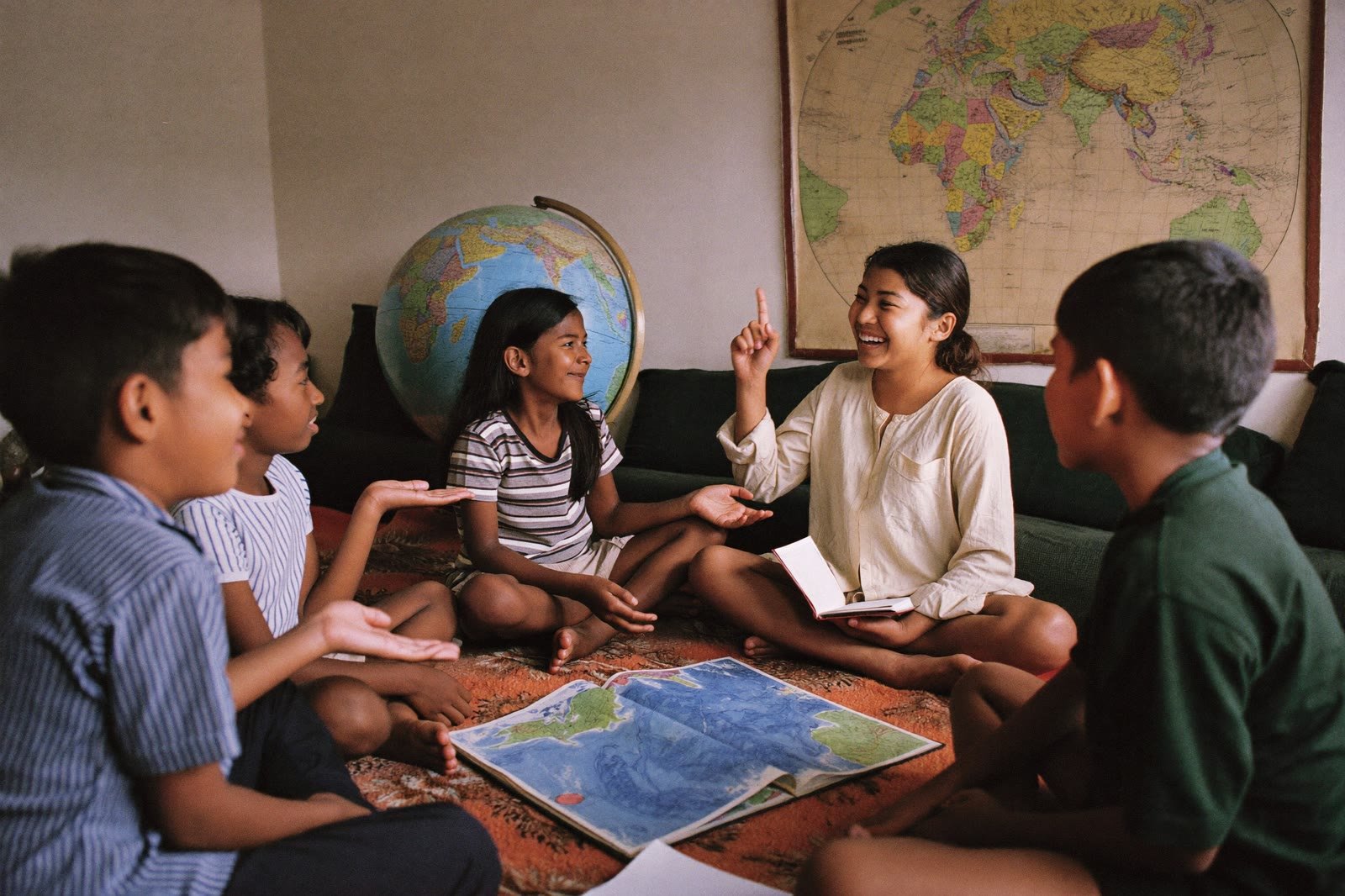
There is no lecture. There is a question, and a room full of children going after it.
We teach through stories, conversations, games, activities and real examples, the point being to turn information into understanding. A class might open with a map, a jar of sand, or an argument about whether zero really counts as a number. Children talk. They disagree. They ask things we had not planned for.
That is the class working, not the class going off track.


A class, start to finish
No two classes are the same, but they all have the same shape.
- The question.Something on the floor or the board that the children cannot leave alone. Why do rivers bend? Who invented zero?
- The story behind it.Where the idea came from, who found it, what it changed. Told, not read out.
- The activity.A map to mark, a model to build, a game to play, an argument to have. Something that makes the idea theirs.
- The discussion.Children explain what they think and why. They build on each other, and they change their minds out loud.
- What goes home.A better question than the one they arrived with, and usually a fact their parents did not know.
How a class runs
| Age | Children per batch | Session length |
|---|---|---|
| Under 7 | Up to 10 | 1 hour |
| 7 to 11 | 10 to 15 | 1 hour to 1.5 hours |
One session a week. Batches are small deliberately. We are not after children sitting quietly and listening. We want them participating, questioning, discussing and connecting, and that only works in a small room.
Tiny Tots and juniors
An hour, in a batch of up to ten. Stories, pictures and things to hold. Children meet the planets, the body, animals and the map of India for the first time, and learn that a question is a good thing to have.
Seniors
Up to ninety minutes, in a batch of ten to fifteen. Discussion, debate and connections between topics. From around nine, current affairs joins, and the world outside the classroom comes into the room.

What children learn
Four levels, each going deeper as children grow, across fifteen topic areas.


Plus the human body, world cultures and festivals, world organisations, history and civilisation, great Indian scholars, entrepreneurs and visionaries, the stories behind great brands, awards and achievements, and Olympic sports. See the full curriculum
What changes after a term
This is what parents tell us they notice.
- They ask better questions: not just what is this? but why does this happen? and what would happen if…?
- They speak up before they are certain
- They explain what they know instead of reciting it
- They mind being wrong less, which is usually when the real learning starts
- They make connections between the class and things they see outside it
- They notice more of the world: countries, people, science, what is in the news
- They get curious past the classroom, bringing facts home and questions to class
- They listen, and build on what someone else said
Who teaches
Every class is run either by Ankieta, who wrote the curriculum and has taught it for seven years, or by an educator trained through The Banyan Tree Teachers Collective, teaching the same curriculum in the same way. Meet Ankieta
Camps and workshops
Separate from the weekly class, and booked separately. We run them through the summer, and festive breaks like Ganpati, Diwali and Christmas. Message us for dates.


What to expect as a parent
- A call before anything is decided, where we answer everything
- A trial class first. The decision is yours after that
- The current fee for your child’s batch, told to you upfront
- The same small batch and the same teacher every week
- A centre near you, or a live online class if there is not
- Camps and workshops in the holidays, if you want them

How to join
- Message us.Tell us your child’s age and where you are.
- We will call.We will answer everything: levels, timings, what your child would actually do in a class.
- Come for a trial.Then decide.